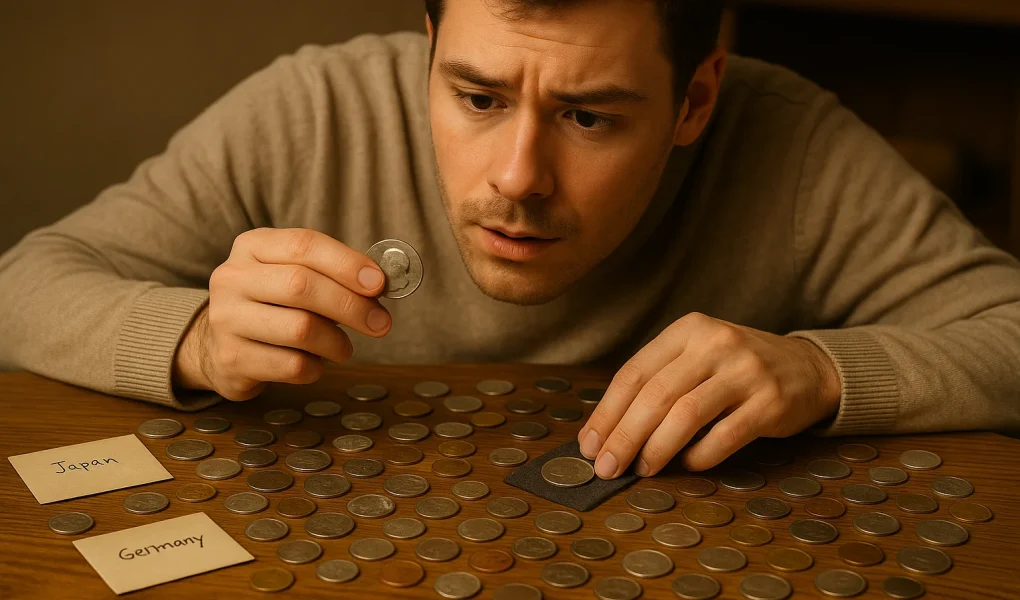
Many beginners enter numismatics through travel, family boxes, or mixed lots. Foreign coins attract attention because they show unfamiliar designs, languages, and histories. A clear system helps turn scattered pieces into an organised world collection. Many people begin with a free coin identifier to classify what they find. It provides a starting point, but a stable method depends on your own observation. Tools help, but clear rules do the rest.
This article explains how to build a simple foreign currency collection, which tools really matter, which starter coins teach the most, and how to expand the set without chasing hype pieces.
Getting Started: Why World Coins Are a Strong Foundation
Foreign coins offer variety, manageable cost, and clear learning value. They teach how different countries mint, change designs, and shift metal composition. You learn to compare shapes, edges, scripts, denominations, and portrait styles. Because most world coins are affordable, mistakes are not costly. Even small coins create a realistic understanding of minting quality and national identity.
A beginner benefits from material that looks different from local circulation. Variety sharpens your eye. You learn to spot relief depth, font styles, alignment, and security elements. These details make later work with older or scarcer pieces easier. World coins also cover different alloys. A euro coin feels different from a Japanese yen or a South African rand. You learn weight differences by handling many examples.
A world collection grows naturally because new pieces appear everywhere – market boxes, travel change, family drawers, and small trades. This steady supply keeps the hobby active without heavy expense.
Choosing a Simple Structure for Your First World Collection
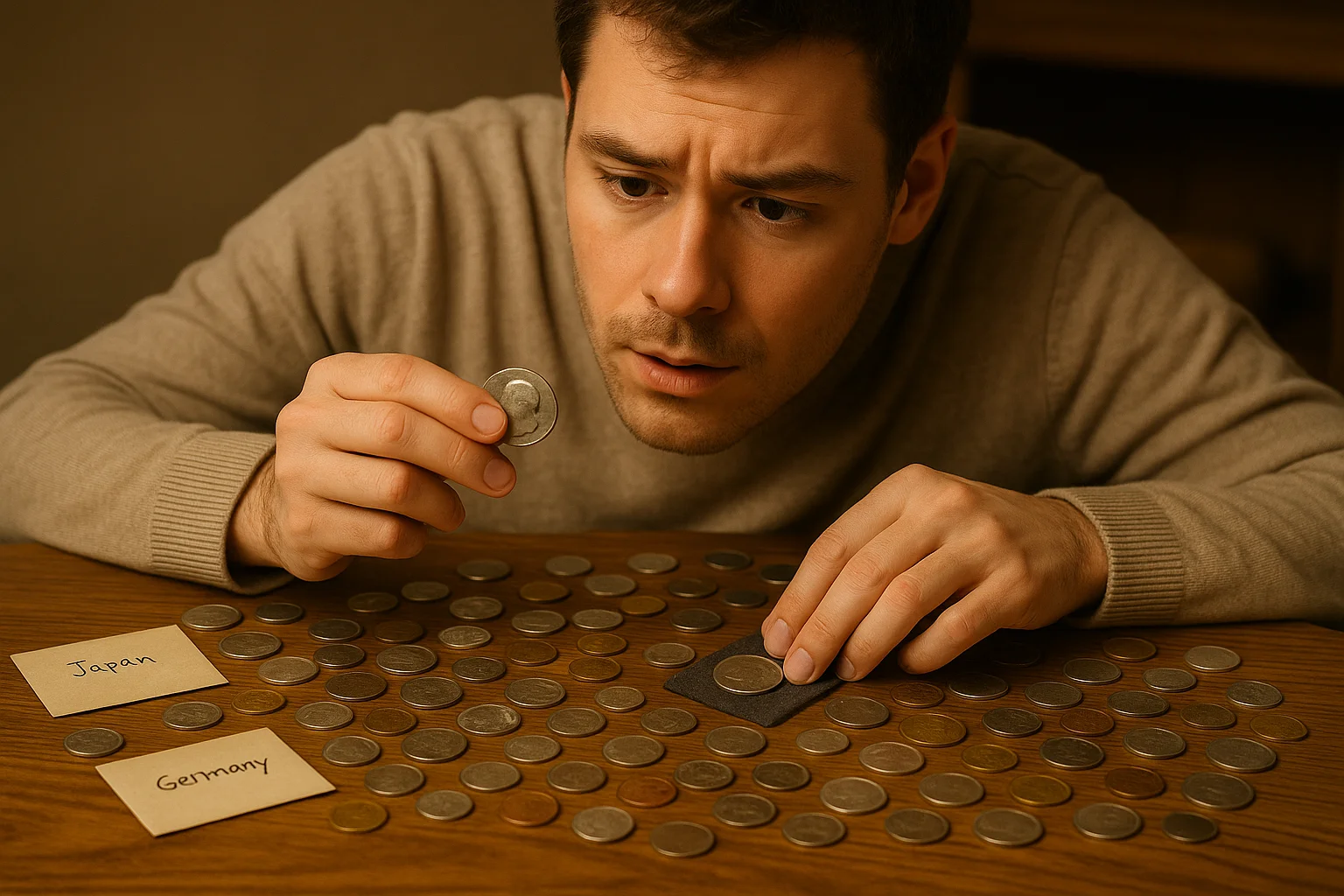
A foreign currency collection stays clear when you give it a simple backbone. Three basic options work well for a first setup:
- By region. Europe, Americas, Asia, Africa, Oceania.
- By period. Pre-euro Europe, early post-Soviet issues, modern bimetallics, etc.
- By theme. Animals, buildings, portraits, plants, or transport.
You can mix them, but keep one main filter. For example, “modern circulation coins from Europe and Asia with animals on them,” or “bimetallic coins from any region.” The structure prevents the common beginner problem: a box of unrelated pieces where nothing connects and nothing suggests a next step.
Cardboard 2×2 holders or simply labelled envelopes help here. On each label, note the country, face value, year, metal, and how the coin entered your collection. Once this habit forms, expansion stays manageable even with hundreds of different types.
Practical Tools for Sorting and Identification
You do not need a laboratory bench initially. At the start, a small, repeatable setup is enough:
- Soft side lighting. A basic LED desk lamp with a flexible neck shows relief and edge details without glare.
- Simple magnifier. A 5×–10× loupe shows dates, mintmarks, and small features without exaggerating every scratch.
- Basic measuring tools. A 0.01-gram digital scale and a plastic calliper confirm the metal type and catch wrong-planchet or fake pieces.
- Clean surface. A dark microfiber cloth for light coins and a light cloth for copper and bronze keep backgrounds neutral.
Digital tools complement this setup. A coin identifier app helps when you sort mixed world bags or inherited boxes. A sharp photo under soft light gives the model enough information to match country, denomination, and date range. Apps also build a digital index, so you do not lose track of what you already own.
The Coin ID Scanner app goes further. The app uses computer vision and a large database of world coins. Just take a photo to receive all data with country, years of minting, metal, diameter, weight, edge type, and typical value ranges. You can save scans into a simple collection view and tag entries with your own notes. That combination: physical tools plus a structured app, covers almost everything a beginner needs at this stage.
A Beginner-Friendly Selection: What to Look For When Choosing World Coins
A beginner should choose coins with clear designs and strong relief. Avoid heavily corroded pieces or coins with unreadable dates. Pick examples that show the typical style of each country. You learn more from healthy pieces than from damaged ones.
Five simple rules guide selection:
- Choose clear dates. This helps you compare periods.
- Choose coins with readable denominations. Unclear text slows learning.
- Choose pieces with intact rims. The rim shape shows how the coin was struck.
- Avoid scratches that hide details. Damage blocks key features.
- Pick a variety of metals. Copper, brass, nickel, and bimetallic coins teach how alloys differ.
Applying these rules creates a set that shows many styles without overwhelming you.
Recommended Starter Coins: World Examples That Teach Real Skills
Below you can see an example of world coins that you can start your collection with. Each example is chosen for clarity, minting quality, and educational value. Looking for them, you can learn distinct styles and help you learn quickly.
Europe: Clear Designs and Strong Relief
| Coin | Key Features | Typical Price Range* |
| 1-euro and 2-euro coins (EU) | Bimetallic design, shared EU layout, unique national reverses | US$1–3 circulated; US$3–8 uncirculated |
| UK 1 Penny / 2 Pence | Large copper-plated coins, strong portraits, clear lettering | US$0.10–0.50 circulated; US$1–3 uncirculated |
| Germany 50 Pfennig (post-war) | Sharp rims, clean mid-century engraving, metal variety across years | US$0.50–1.50 circulated; US$3–6 uncirculated |
*Prices vary with grade and supply.
Short Notes
1-euro / 2-euro coins: Good for learning bimetallic structure and national variations. Relief patterns stay stable, so comparisons are easy.
UK 1p / 2p: Large surfaces show wear clearly. Lettering remains readable in most grades, useful for beginners.
Germany 50 Pfennig: Consistent strikes help you study mid-century minting and metal changes from decade to decade.
Asia: Mixed Metals and Strong National Themes
| Coin | Key Features | Typical Price Range* |
| Japan 100 Yen (modern) | Nickel composition, crisp relief, stable portraits | US$1–2 circulated; US$3–5 uncirculated |
| South Korea 100 Won | Clean typography, consistent rims, durable alloy | US$0.50–1 circulated; US$1–3 uncirculated |
| India 1 Rupee (post-2000) | Multiple mintmarks, varied designs, easy to sort | US$0.10–0.30 circulated; US$0.50–1 uncirculated |
*Prices vary with grade and supply.
Short Notes
Japan 100 Yen: Reliable for studying sharp strikes and hard alloys.
South Korea 100 Won: Helps train the eye for rim thickness and consistent lettering.
India 1 Rupee: Excellent for learning mintmark positions and design transitions.
Latin America: Distinct Fonts and Stable Denominations
| Coin | Key Features | Typical Price Range* |
| Mexico 1 Peso (new series) | Modern fonts, clear mintmarks, stable circulation wear | US$0.20–0.50 circulated; US$1–2 uncirculated |
| Argentina 1 Peso | Large portraits, strong date placement, varied alloys | US$0.10–0.40 circulated; US$1–2 uncirculated |
| Brazil 50 Centavos | Deep numerals, clean outer ring, stable modern strikes | US$0.20–0.50 circulated; US$1–2 uncirculated |
*Prices vary with grade and supply.
Short Notes
Mexico 1 Peso: Good for practising mintmark recognition (Mo).
Argentina 1 Peso: Clear portrait lines help with studying wear patterns
Brazil 50 Centavos: Strong numerals make doubling or wear differences easy to see.
Africa: Strong Geometric Designs and Durable Alloys
| Coin | Key Features | Typical Price Range* |
| South Africa 1 Rand | Clean wildlife themes, durable nickel-based metal | US$0.20–0.50 circulated; US$1–3 uncirculated |
| Kenya 5 Shillings | Multi-metal issues, bold text, stable modern strikes | US$0.50–1 circulated; US$1–3 uncirculated |
| Morocco 1 Dirham | Clear numerals, bilingual text, and distinct edge patterns | US$0.20–0.50 circulated; US$1–2 uncirculated |
*Prices vary with grade and supply.
Short Notes
South Africa 1 Rand: Wildlife motifs make relief depth easy to judge.
Kenya 5 Shillings: Multi-metal construction helps compare ageing on different alloys.
Morocco 1 Dirham: Strong numerals and dual script help with studying fine engraving.
Middle East: Sharp Calligraphy and Metal Variations
| Coin | Key Features | Typical Price Range* |
| Turkey 1 Lira | Bimetallic format, clean portraits, firm edges | US$0.50–1 circulated; US$1–3 uncirculated |
| UAE 1 Dirham | Clear calligraphy, smooth strike, stable alloy | US$0.20–0.40 circulated; US$1–2 uncirculated |
| Israel 1 New Shekel | Modern fonts, consistent rims, strong national symbols | US$0.30–0.60 circulated; US$1–2 uncirculated |
*Prices vary with grade and supply.
Short Note
Turkey 1 Lira: Teaches comparison between nickel-brass rings and steel cores.
UAE 1 Dirham: Smooth relief helps beginners spot damage faster.
Israel 1 Shekel: Strong rim consistency supports learning about strike pressure.
Building and Tracking Your World Set Over Time
Once a few starter coins are on the table, the next task is control. Without a system, a world collection turns into a random box again. The simple steps below work well.
Stage 1: wide net. Accept almost any foreign coin that is cheap or free. Focus on condition and basic labelling.
Stage 2: filter by structure. Decide which regions, themes, or metals you want to keep. Begin trading out pieces that do not fit.
Stage 3: targeted upgrades. Replace worn examples with better grades. Add missing dates or design variations within your chosen scope.
Here, digital tools help a lot. You can keep one physical album per region and a digital register that stores photos and notes. If you use Coin ID Scanner, each scan becomes a coin card with country, years, metal, and an indicative market range, plus your own tags for “upgrade later” or “keep as type example.” That mix of paper labels and app records lets you handle larger groups without losing track.
Where to Find Foreign Coins Without Overspending
Foreign coins reach your desk in several ways. The best sources for beginners:
- Travel change. Save every foreign coin that comes back from a trip. Friends and relatives often add to this pile.
- Dealer world boxes. Many shops keep “pick bins” where you pay a fixed price per coin. These are ideal for structured hunting.
- Online mixed lots. Auction sites and platforms sell kilogram bags or small assortments of world coins. Start with small lots to check quality.
- Swaps with other collectors. Trading duplicates from your own country for their foreign pieces builds both sets.
When you buy lots, watch postage and per-coin cost. Weigh the bag, check how many coins you realistically want from the mix, and compare that to what you would pay in a local pick box. Use your coin app for Android and iOS to sample a small portion of a lot when it arrives. If you see mostly heavily worn or very small denominations, treat the purchase as learning material, not as an investment.
FAQs: Practical Questions About Starting a World Coin Collection
- How many countries should I start with?
Two or three regions are enough. For example, Europe plus Asia, or the Americas plus Africa. Too many at once makes it hard to learn patterns.
- Are modern world coins actually collectable if most are only worth face value?
Yes. Many modern pieces have excellent designs and interesting mint changes. Value comes from condition, completeness of sets, and personal focus, not only from high catalogue prices.
- Is it better to buy one expensive foreign coin or many cheap ones?
For beginners, many inexpensive coins give more experience. You learn more from comparing fifty different types than from guarding one costly piece.
- Can I rely only on a free coin identifier for cataloging?
Yes, these apps are useful for quick checks. It should not replace physical inspection or basic measuring. Combine scans with weight, diameter, and visual checks to avoid wrong matches.
- Do I need to understand every language on the coins I collect?
No. Learn how to read dates, denominations, and a few key words like “bank,” “state,” or “republic” in major languages. Reference books and apps handle the rest.
- How should I store foreign coins to avoid corrosion?
Use PVC-free flips, capsules, or cardboard 2×2 holders, keep them in a dry room away from direct sunlight, and avoid storing coins in paper envelopes long-term for higher-grade pieces.
- What is a reasonable budget for starting a world coin collection?
Small dealer boxes and online lots let you start with 20–50 coins for the price of a single restaurant meal. Focus on condition and structure rather than total volume.
- When should I think about grading or a professional evaluation?
Only when a coin appears truly scarce for its type, shows an unusual error, or reaches a value that would matter if sold. Until then, use your tools and common references to learn.
A Collection That Builds Itself
A world coin collection grows quickly once you give it a bit of structure. You can find new pieces from travel, trades, and small finds, and each one teaches something about design, history, or metal. Use the modern app and follow these simple rules to try an affordable coin collecting and always moving forward. And the more coins you handle, the clearer patterns become. And finally, your “starter set” turns into a worthy collection.